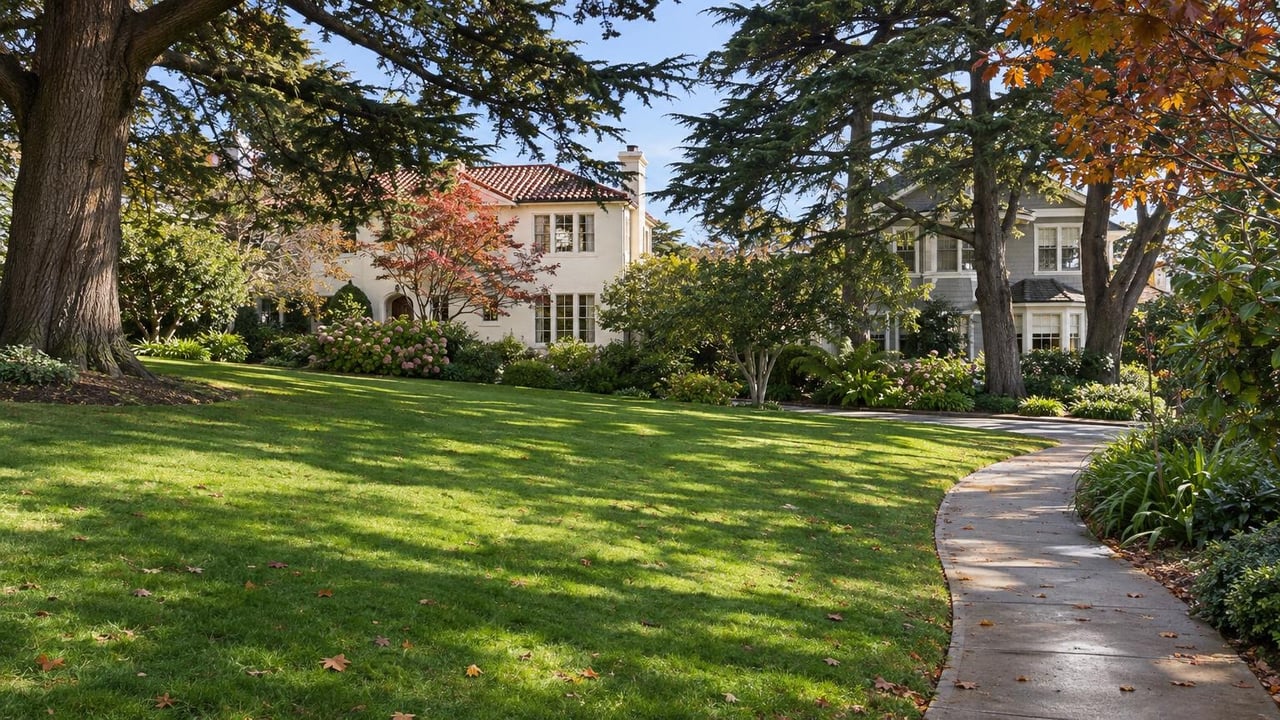
The long lawn at Terrace Green Park runs between Terrace Drive and Santa Clara Avenue. It has trees and shrubs along its edges, a basketball court in the southwest corner, and a play area and two tennis courts at the east end. The Olmsted Brothers drew it into the original plan as a place where children and adults could play, with lawns, tennis courts and a clubhouse set on three graded levels. It looks like a small city park, but it isn't one. The St. Francis Homes Association owns and maintains it, and it is for the private use of residents and their guests.
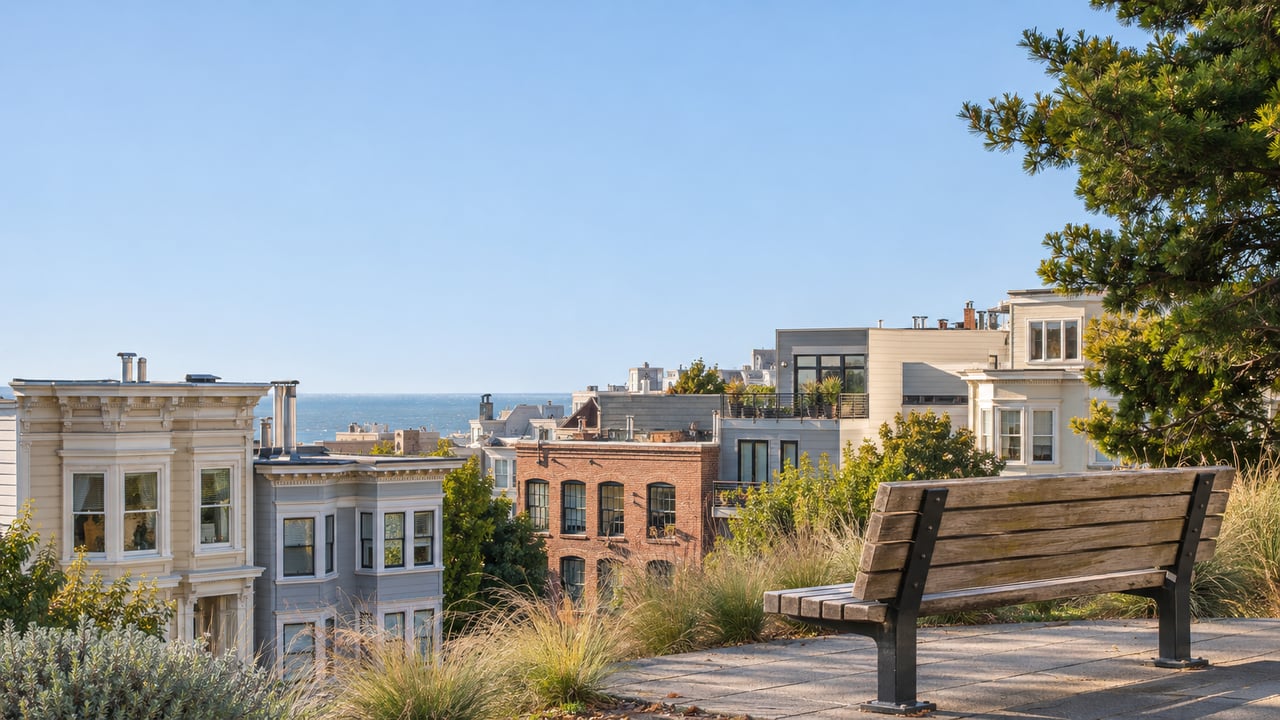
That fact sets St. Francis Wood apart from its neighbors west of Twin Peaks. Forest Hill, Westwood Park, Ingleside Terraces and Monterey Heights, all early-1900s residence parks nearby, each have an association too, but what each one owns and maintains varies a great deal. In St. Francis Wood, buying a house means access to association-owned parks and to parkways, greenbelts and a fountain that the association keeps up. In the other neighborhoods, the association may care for a historic clubhouse, a pair of gate pillars or a calendar of social events. A buyer comparing these neighborhoods by price per square foot is comparing different purchases.
What 561 Houses Share
According to the St. Francis Homes Association, St. Francis Wood has 561 single-family homes on about 127 acres. Shared among them are a children's playground, tennis and basketball courts, many small parklets and more than 7 miles of parkways. The association manages landscape care for the tall eucalyptus trees, the greenbelts, the fountain and the terraced plaza. Besides Terrace Green, its parks page lists Santa Monica Park, St. Francis Park and St. Francis Plaza.
These grounds were planned from the start. The Mason-McDuffie Company began selling St. Francis Wood on October 12, 1912. The association's history page says the landscape features were meant to be "reminiscent of the loveliest gardens of the Italian Renaissance," and included a formal gateway and two fountains along St. Francis Boulevard. The Olmsted Brothers laid out the curving streets. John Galen Howard designed the lampposts, the brick-diamond sidewalks, the entry pillars, the main gate and the first fountain, and Henry Gutterson designed the larger upper fountain. The houses came over time: 46 were built from 1912 to 1918, and 347 in the 1920s. Our primer on St. Francis Wood's architectural styles covers the Mediterranean, Tudor and French Revival houses along these streets.
For a buyer, this means much of what makes St. Francis Wood feel like St. Francis Wood is kept up by the homes association rather than by the city. The parks are association property, and the parkways, greenbelts and fountain are on the association's maintenance list. For shopping, the about-us page points residents a few blocks north to West Portal, where the light rail runs through the Twin Peaks tunnel to downtown. We wrote last summer about how West Portal Avenue works as St. Francis Wood's main street.
Forest Hill Centers on a Clubhouse
Forest Hill, just to the north, has a different arrangement. The Forest Hill Association, incorporated on March 12, 1918, centers on its clubhouse. Bernard Maybeck, the architect of the Palace of Fine Arts, designed the building, and it was finished in 1919 as the gathering place for the new neighborhood. The association's site describes an Arts and Crafts interior with a great room under a tall beamed ceiling, a mezzanine, original woodwork, original light fixtures with mica shades and some of the original furniture. The Forest Hill Garden and Social Club was founded in 1931 by eleven women of the neighborhood and is open to all association members.
The association also takes care of shared landscaping. It maintains the sidewalk strips and medians, including routine tree and hedge care, and it provides tree service to members. Forest Hill and St. Francis Wood are both well-kept residence parks with an active association. The difference is in what that association holds. Forest Hill's shared life centers on one landmark building. St. Francis Wood's is spread across its parks and boulevards. Our Forest Hill neighborhood page covers the area in more detail.
Westwood Park Shows What Upkeep Costs
Gates, pillars and old trees need regular money. Westwood Park, south of Ocean Avenue, makes that clear. According to the Westwood Park Association, property owners pay annual dues that go mainly to maintaining the historic gates, the trees and the neighborhood landscaping.
In 2024, the association won a little over $27,000 through the district supervisor's participatory budget process to restore its pillars at Monterey and Ocean and at Miramar and Ocean. The association's Summer 2026 newsletter reports that the grant paid for plates under the Monterey pillar lights. The board then used association funds in 2025 to remove rust from the wrought iron and stabilize the pillars before the rainy season. The board is still looking for outside funding to finish the work and has said it may use association funds if none comes through. The same issue reports that two historic landmark plaques recognizing Westwood Park's status as a San Francisco Landmark have been purchased for installation.
The trees follow the same pattern. On May 27, two Samuel Sommers magnolias were planted on Miramar near Westwood, replacing two trees that fell on December 25, 2025, and the old stumps were ground out. None of this is out of the ordinary. Shared historic features need ongoing work, and an association with its own funds can keep that work moving. Any buyer looking at a residence park can ask what is on the association's current project list and how it plans to pay for it.
At the Other End, Voluntary Dues
Ingleside Terraces sits at the other end of the range. The Ingleside Terraces Homes Association represents all homeowners and residents, and its annual dues are "voluntary but encouraged." It lists four levels: $40 Basic, $80 Supporter, $100 Patron and $250 Benefactor. The dues support the mini-parks and circles, the gateways and pillars, and graffiti removal in the parks and common areas. In Monterey Heights, the homeowners association lists annual dues of $27, and the page says the money supports neighborhood gatherings and community activities.
So the range runs from association-owned parks with tennis courts and seven miles of parkways to a $27 fund for neighborhood events. Each of these neighborhoods can accurately say it has a homes association. Those dues and contribution levels are as each association lists them on its website as of this month. This post is general information, not legal, tax or financial advice. Confirm the obligations that come with any specific property with your own attorney and the association itself.
What a Fall 2026 Sale Showed
The market has been very competitive this fall. The San Francisco Chronicle reported on October 7 that a St. Francis Wood house was listed at $4.5 million in early September. It drew six offers, five of them all-cash, and closed 20 days later at $6.6 million. The sale price was about 47 percent above the asking price, or $2.1 million over list.
Two other figures from that Chronicle article help explain the result. Dierdre O'Connor of Old Republic Title studied San Francisco sales from January 1 to September 1, 2026. Above $4 million, 64 percent of single-family homes closed with no loan. Above $7 million, 79 percent did. That matters because the 30-year fixed mortgage rate had climbed to 7.28 percent in the Freddie Mac survey the Chronicle cited for late September. At St. Francis Wood's price level, most buyers are not borrowing at that rate.
For the citywide picture, The San Francisco Standard reported that 86 percent of the city's single-family homes sold in October 2026 went above asking. The average sale was 28 percent over list and took 14 days. In an October 25 piece, the Standard reported, citing Compass data, that the city had its fewest September listings since 2020, and that sales above $5 million were up 109 percent from a year earlier. The St. Francis Wood sale closed in September, so its overbid can't be compared directly with the October average. Even so, it closed at 47 percent over list in a month when the citywide shortage was already pushing prices up.
A buyer bidding at that level is paying for a house in a 561-home neighborhood where the association owns four parks and maintains the parkways, the eucalyptus, the greenbelts and the fountain. A Forest Hill house comes with membership in an association built around a Maybeck clubhouse. An Ingleside Terraces house comes with a voluntary association that funds its mini-parks and gateways. For sellers, our earlier piece on selling an estate home in St. Francis Wood covers how these houses are prepared and presented.
Questions Buyers Ask About West-Side Associations
Can the public use the parks in St. Francis Wood? The St. Francis Homes Association says its four parks and green spaces are owned and maintained by the association for the private use of residents and their guests.
Are association dues the same across the west-side residence parks? No. Ingleside Terraces lists voluntary levels from $40 to $250 a year, and Monterey Heights lists $27 a year. Westwood Park and Forest Hill associations both collect money for shared upkeep. Each association should give you current figures directly.
Where is the nearest retail and transit? West Portal is a few blocks north of St. Francis Wood, with shops along the avenue and light rail to downtown through the Twin Peaks tunnel.
If you are weighing St. Francis Wood against Forest Hill or another west-side residence park, Rossi Real Estate can go over what each association owns and maintains and how recent sales in each one have closed, before you write an offer. Schedule a private consultation.