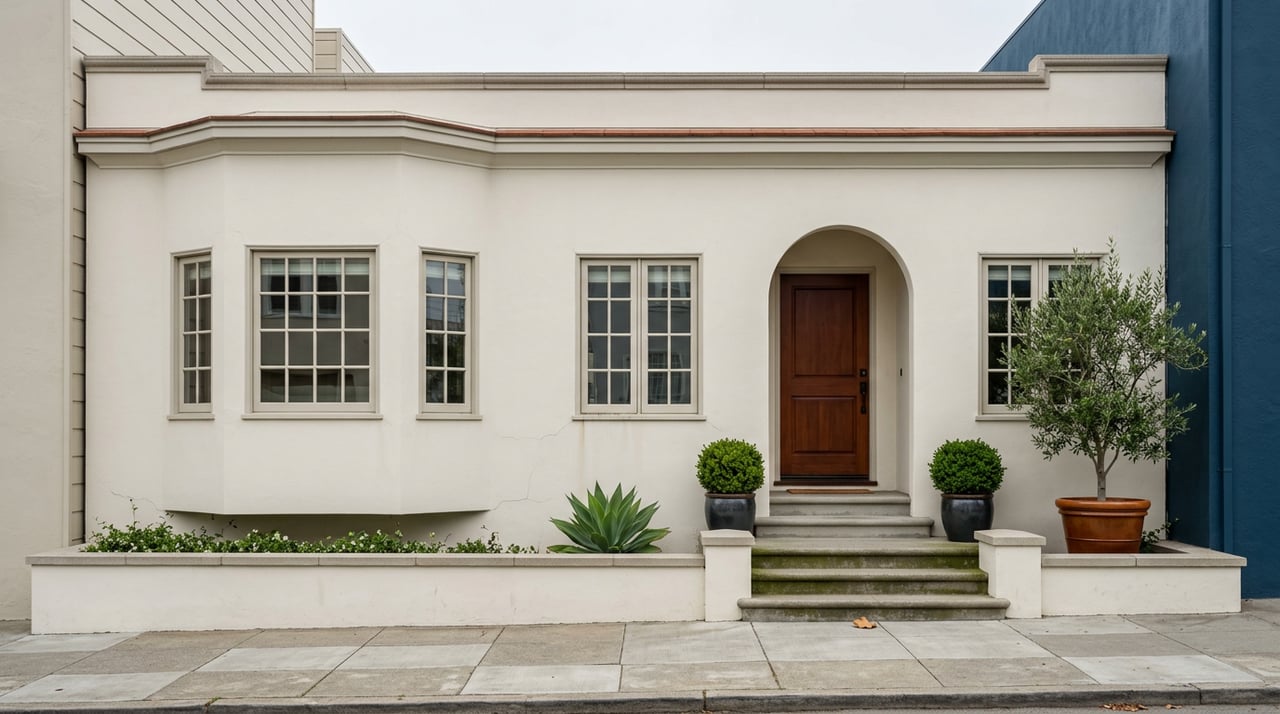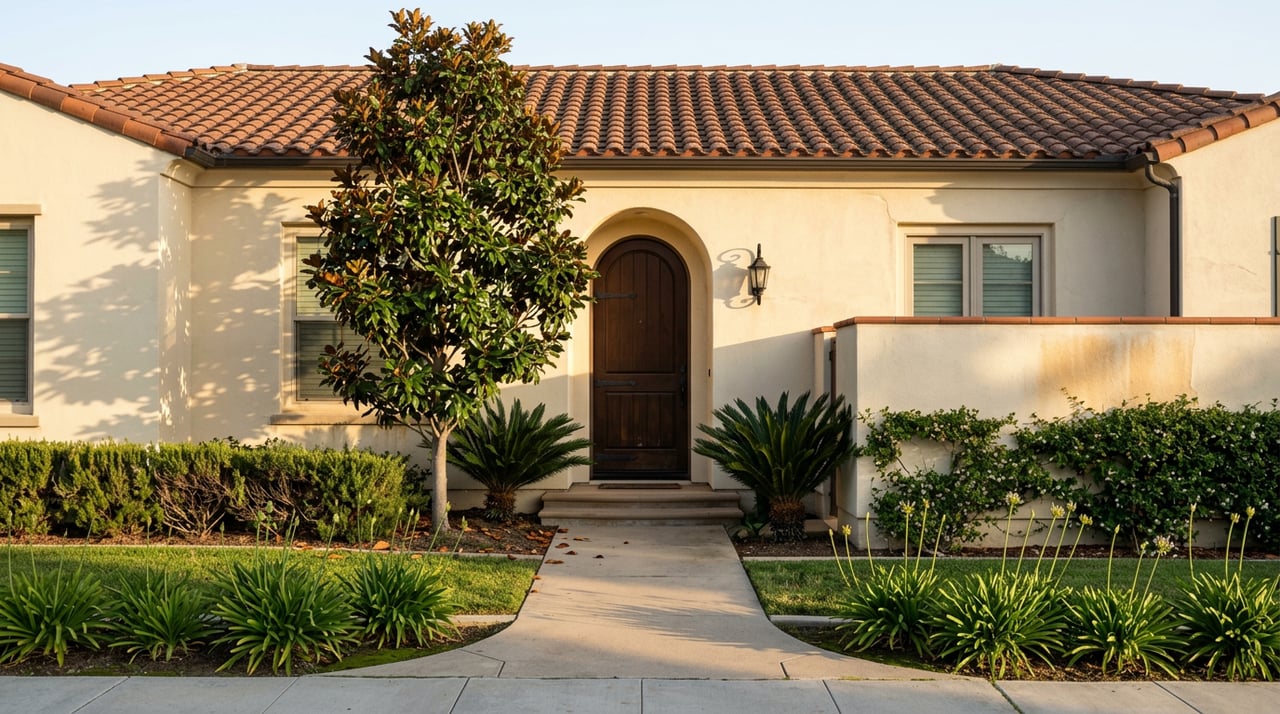
Walk any block of St. Francis Wood and you will not pass a single storefront. No coffee shop wedged between houses, no corner market, no dry cleaner with a hand-lettered sign. That absence is not an accident of zoning that never caught up. It was written into the plan before the first house went up.
Which is why what happens ten minutes away, on West Portal Avenue, matters more here than it would almost anywhere else in the city.
A Neighborhood Designed to Send You Elsewhere
St. Francis Wood was laid out in 1912 as one of San Francisco's original residence parks, with curvilinear streets, landscaped medians, and monuments designed by the Olmsted Brothers, the same firm behind Central Park and much of the country's early planned suburban work. The design borrowed from the City Beautiful movement's belief that a neighborhood's dignity came from what it left out as much as what it included. What it left out, deliberately, was commerce. The result today is a neighborhood with a low profile compared to more storefront-heavy wealthy enclaves like the Marina or Pacific Heights, precisely because it was never meant to have a front door onto retail.
That covenant pushed every daily errand outward. For over a century, the closest thing to a Main Street for St. Francis Wood residents has been West Portal Avenue, a flat, walkable corridor that sits just north of the neighborhood and functions as its unofficial commercial spine. When people talk about what it feels like to live here, they are usually describing something that happens a few blocks away.
This year, that outward-facing corridor is having a moment worth paying attention to, and the timing lines up with a second free amenity on the neighborhood's other edge.
The 88-Year Anchor That Just Let Go
For nearly a century, 32 West Portal Ave meant one thing: Papenhausen Hardware, a fixture so embedded in the corridor's identity that its closing in 2024 left an actual gap in the block. That gap closed this spring. Hardware Coffee Co. opened on the site in May 2026, run by former tech worker Sam Pederson and funded entirely by his family rather than outside investors. The space keeps the old name as a nod to its predecessor, pours coffee from Oakland's Grand Coffee Roasters, and pairs the counter with a full-service florist run by Dasluz founder Sandra Bautista. It joins George's Donuts & Merriment and Ballast Coffee as part of a food and drink scene that has been filling in the avenue's gaps for several years, alongside longer-established competition from a Starbucks and a Peet's on the same stretch.
An 88-year-old hardware store closing and a coffee-and-flower shop opening in its place is not, on its own, remarkable. Storefronts turn over in every city. What makes it worth noting here is that the block just down from the Hardware Coffee site is also home to a proposal to replace the Empire Theater with a nine-story residential building, a debate that has kept questions about the corridor's future genuinely open rather than settled. St. Francis Wood residents do not have a vote on their own commercial district, because they do not have one. They have a stake in someone else's.
The Recognition Catching Up to the Reality
The change on West Portal Avenue is not just a matter of a few new tenants. In 2026, West Portal was named the top neighborhood in SFGATE's Best of Bay Area contest, a reader vote that drew more than 29,000 voters and 167,000 votes across the Bay Area. Local businesses on the avenue picked up category wins too, including Von Rock Law and West Portal Lutheran School.
That result tracks with what the SF Standard reported in June 2026, describing a stretch that has gone from a sleepy, old-fashioned strip to a place people now travel to on purpose to eat, not just a neighborhood that happens to have decent food. The shift did not come from a single flagship opening. It has been building for a couple of years now, the same instinct that brought Hardware Coffee's owner in, and the one that brought Dan Spangler and Julia Paige to the avenue in 2025, when the Ingleside Terraces couple opened a West Portal location of their specialty grocer, Spangler's Market, expanding out of their original Half Moon Bay store.
For anyone who has spent a decade hearing West Portal described as a nice but unglamorous errand strip, this is the year that description stopped being accurate. The restaurants that already anchored the avenue, among them Orexi, Bursa, Little Original Joe's for a slice that regulars will argue about, and Elena's Mexican for margaritas and warm tortilla chips, are no longer the exception on a quiet block. They are the baseline a new wave of openings is trying to match.
The Free Season on the Other Edge
A short drive from St. Francis Wood, on the other side of Ocean Avenue and 19th Avenue, sits Sigmund Stern Grove, and this summer that park is doing more work than usual for anyone in the surrounding blocks. The Stern Grove Festival, the country's longest-running free outdoor concert series, is in its 89th season, running every Sunday from June 14 through August 16, 2026, inside a natural amphitheater ringed by eucalyptus and redwood.
The season closes with its two-day Big Picnic Weekend this Saturday and Sunday, August 15 and 16, and the lineup is not a warm-up act situation. Public Enemy headlines Saturday. Al Green closes the season Sunday. Getting in requires planning rather than a walk-up:
- Tickets are free but distributed through an online lottery that opens six weeks ahead of each show, plus a limited first-come, first-served allotment at Community Box Offices the day before.
- Gates open at noon for a 2 p.m. start, and shows run two to three hours regardless of the marine layer that tends to settle over this side of the city even in August.
- Seating is general admission on the grass, so a blanket and warm layers matter more than an early wardrobe choice would suggest.
For a household in St. Francis Wood, this is not a special-occasion outing. It is a short trip to a world-class free concert series that happens to end its season with two legacy acts the same week most of the country is paying full price to see them elsewhere.
What Changes, What Doesn't
It would be easy to read the last few months on West Portal Avenue as a neighborhood transforming overnight. It is worth resisting that framing. West Portal Produce Market, at 222 West Portal Ave, has been run by the same family since 1980, when Young H. Choe opened it, and it still sits a few doors down from the new coffee shop that just replaced an 88-year-old hardware store. Both things are true on the same block at the same time. The corridor is absorbing new operators without discarding the ones who built its reputation in the first place.
That is, in the end, the real shape of the story. St. Francis Wood was designed without a commercial center because its planners believed a neighborhood's character could live entirely in its residential fabric, with everything else handled somewhere close by but not within it. A century later, that arrangement still holds, and the two places doing the work, a changing avenue and a free concert season at the edge of a park, are both, this particular August, performing better than they usually do. Living here has always meant trusting the perimeter to carry the neighborhood's daily life. Right now, the perimeter is delivering.
If you are weighing what a home in St. Francis Wood or one of San Francisco's other close-knit enclaves is actually worth in a market that keeps shifting month to month, that kind of neighborhood-level detail is exactly where the real answers live, not in a median price alone. Heidi Rossi has spent almost three decades reading these blocks street by street. When the time comes to talk through what that means for your own plans, schedule a private consultation.